
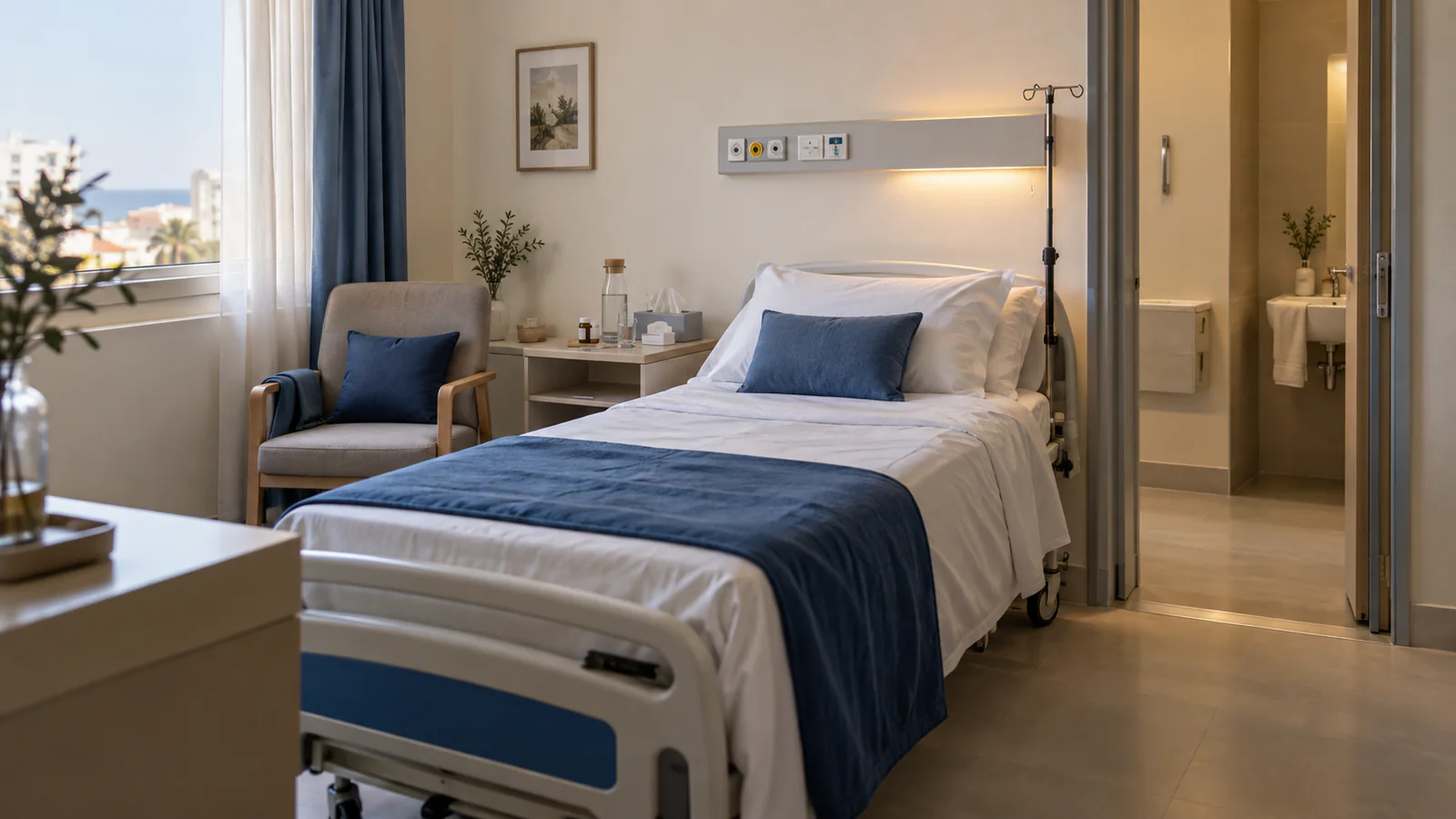
Recovery accommodation should make it easier to follow the care plan. After cosmetic surgery, the best room is not necessarily the most luxurious one; it is the one that is close enough to care, easy to move around in, quiet, practical and flexible if you need to stay longer.
Before booking, think about your actual first days after surgery rather than the holiday you might normally plan in Tunisia.
Ask where you will spend the first night
The first question is not hotel category. It is where the surgical team expects you to recover.
Ask:
- Will I stay overnight in the clinic?
- If discharged the same day, when do I go to accommodation?
- Does someone need to stay with me?
- Is nursing support available or required?
- How far is the accommodation from the clinic?
- What happens if I need to return during the night?
Do not assume every “all-inclusive” package uses the same aftercare model.
Stay close enough to the surgical team
A beautiful hotel far from the clinic may be inconvenient if you need:
- an early follow-up;
- a dressing review;
- drain or suture care;
- an unexpected assessment.
Ask how long the drive normally takes at the times you may need to travel.
Also ask who arranges transport if an extra clinic visit becomes necessary.
Check access before you book
After surgery, stairs, long corridors and difficult bathrooms may matter more than they normally would.
Check:
- elevator access;
- stairs from entrance to room;
- distance from reception;
- walk-in shower or easy bath access;
- stable chair;
- bed height;
- bathroom proximity;
- air conditioning or heating;
- ability to darken the room;
- quietness.
If your mobility will be limited, request a room that reduces unnecessary walking.
Think about the procedure
Different procedures create different practical needs.
Examples:
- abdominal or breast surgery may make bending and getting out of bed harder;
- facial procedures may make sleeping position important;
- liposuction may involve garments and frequent clothing changes;
- hair-transplant recovery can make head positioning relevant.
Ask the surgical team what room features matter for your operation.
Do not buy special pillows, medical beds or equipment unless the team actually recommends them.
Make food and water easy to access
Recovery may reduce your desire to go out.
Before surgery, know:
- where you can get meals;
- whether room service is available;
- whether delivery is allowed;
- whether there is a refrigerator if needed;
- whether drinking water is easy to obtain;
- whether the accommodation can handle simple dietary requests.
Follow your clinician’s dietary instructions rather than internet postoperative diets.
Plan medication storage
Ask whether any prescribed medicine needs:
- refrigeration;
- protection from heat;
- secure storage.
Keep medicines in a place you can reach easily and do not scatter them between several bags.
A written medication schedule can help, especially if a companion is helping.
Decide whether you need a companion
Ask the surgical team whether you should have someone with you.
A companion can help with:
- transport;
- luggage;
- collecting food or medicines;
- getting to follow-up;
- communication;
- basic practical tasks.
See Companion support during a medical trip.
If you are traveling alone, ask what support the clinic or accommodation can realistically provide.
Clarify nursing claims
Some packages advertise “nursing care,” but the phrase can mean very different things.
Ask:
- Is the person a licensed nurse?
- Are they based at the hotel or on call?
- What hours are covered?
- What tasks do they perform?
- Do they communicate with the surgeon?
- Is this included in the price?
- What happens outside those hours?
A hotel receptionist or coordinator is not the same as clinical nursing support.
Plan transport between clinic and accommodation
Do not assume you will be comfortable using normal taxis immediately.
Ask:
- Who takes you from clinic to accommodation?
- Is someone with you?
- Is the vehicle easy to enter and exit?
- What happens if discharge is delayed?
- Who provides transport for follow-up?
- Is the cost included?
If the package includes transfers, ask exactly which transfers.
Keep essential items within reach
Arrange the room so you do not repeatedly bend, stretch or walk.
Useful items may include:
- phone;
- charger;
- water;
- prescribed medicines;
- written instructions;
- tissues;
- simple toiletries;
- clinic contact details.
Follow your surgeon’s activity restrictions.
Do not turn the hotel into a holiday schedule
CDC medical-tourism guidance warns that common vacation activities can interfere with healing.
Avoid planning the early recovery period around:
- swimming;
- sun exposure;
- alcohol;
- long walks;
- sightseeing;
- gym or exercise.
The accommodation is a recovery base first.
Make extension easy
Recovery may change your travel date.
Before booking, ask:
- Can the room be extended?
- What is the extra-night rate?
- Are there blackout dates?
- Can a companion extend too?
- Can airport transfer be changed?
- What happens if you need to move rooms?
Flexible accommodation reduces pressure to travel before you are ready.
For the bigger timing decision, see How long to stay in Tunisia after surgery.
Keep the emergency plan visible
Know:
- clinic phone number;
- after-hours medical contact;
- accommodation address;
- nearest appropriate emergency service;
- how to call transport;
- who your companion should contact.
For non-urgent follow-up, use Communication after surgery. For a significant new concern, use What to do if worried after surgery abroad.
Accommodation checklist
Before booking, confirm:
- Distance to clinic
- Elevator / low-stair access
- Easy bathroom access
- Quiet room
- Appropriate temperature control
- Meal access
- Water access
- Refrigerator if medically needed
- Companion policy
- Nursing support details if advertised
- Transport to clinic
- Flexible extension
- Clear address for emergency use
- Reliable phone/internet access
Questions to send the provider
- Where do patients stay the first night?
- How far is the accommodation from the clinic?
- Who transports me after discharge?
- Is someone required to stay with me?
- What medical or nursing support is available?
- What follow-up transport is included?
- Can I extend the room if travel is delayed?
- Who do I call at night if I have a problem?
Key takeaway
Choose recovery accommodation for access, practicality, proximity, support and flexibility.
The goal is to reduce unnecessary effort and make follow-up easier—not to create a postoperative holiday itinerary.
Sources
- CDC Yellow Book — Medical Tourism: https://www.cdc.gov/yellow-book/hcp/health-care-abroad/medical-tourism.html
- NHS — Cosmetic surgery abroad: https://www.nhs.uk/tests-and-treatments/cosmetic-procedures/advice/cosmetic-surgery-abroad/
- Royal College of Surgeons — Cosmetic surgery abroad: https://www.rcseng.ac.uk/patient-care/cosmetic-surgery/having-surgery-abroad/