
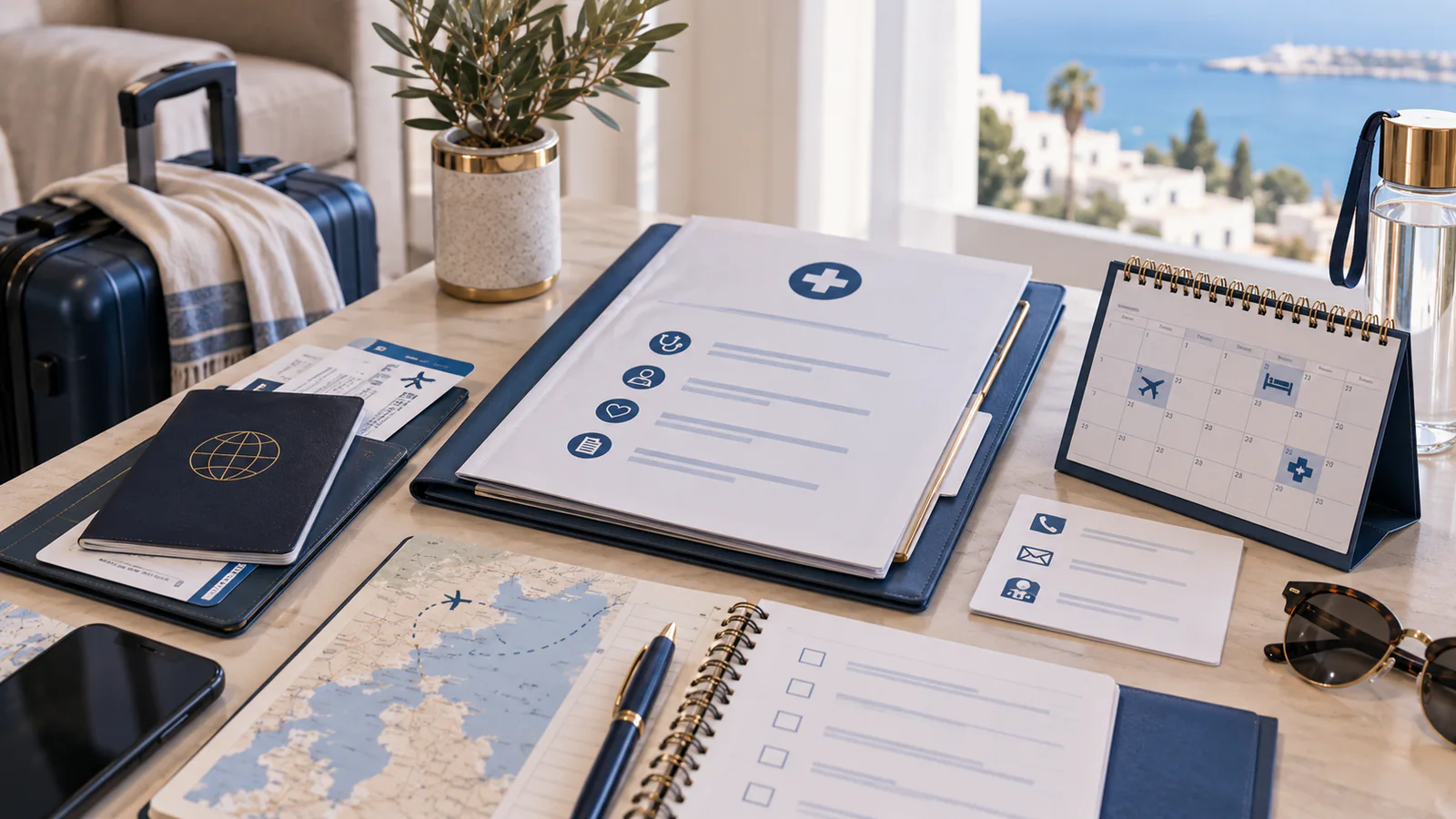
1. Build four document folders, not one pile of paperwork
A single envelope containing passports, laboratory results, receipts and prescriptions becomes difficult to use when you actually need something.
Create four folders, physical or digital:
- Travel / border — passport, visa if required, accommodation and return/onward booking.
- Medical handover — relevant history, test results, medicine and allergy information, prescriptions and the provider's pre-operative instructions.
- Financial / insurance — written quote, booking terms, payment receipts, insurance certificate and assistance numbers.
- Return-home records — discharge summary, procedure record, medication plan, follow-up instructions, implant/device details where applicable and final invoices.
That structure also makes it easier for a companion to find information if you are tired or unwell after surgery.
2. Entry documents: verify the rule for your nationality
Tunisia sets and enforces its own entry rules, and passport/visa requirements are not identical for every nationality.[1]
This is why Curaatlas does not publish one universal statement such as “everyone can enter visa-free for 90 days.”
For example, current UK guidance for people travelling on a full British citizen passport says the passport should be valid for the duration of the stay and that a visa is not required for visits of up to 90 days.[1] Current U.S. travel guidance uses different passport-validity wording for U.S. citizens while also saying that no tourist visa is required for 90 days or less.[2]
The lesson is simple: check an official source that applies to your passport.
Before travelling, confirm:
- passport validity required for your nationality;
- whether you need a visa;
- permitted length of stay;
- whether transit countries impose separate document rules;
- whether a minor or dual national needs additional documents.
Do this again shortly before departure because entry rules can change.
Keep these border documents easy to reach
UK government guidance notes that Tunisian border officials may ask visitors for contact details, onward or return tickets and proof of a hotel booking or other accommodation.[1]
For a medical trip, keep accessible:
- passport;
- visa or authorization if required;
- return or onward ticket;
- hotel / recovery-accommodation confirmation;
- clinic or provider address and telephone number;
- a basic itinerary with your arrival, clinic and accommodation details.
Do not put all of this only in checked luggage.
3. Your medical handover file before you leave home
The overseas medical team does not need every medical document you have ever received. It needs the information relevant to assessing and treating you safely.
CDC guidance for medical travellers recommends bringing relevant medical records and test results, informing the destination team about allergies, and carrying a list of medicines and prescriptions.[3]
Your file may include, depending on what your treating team has requested:
- a concise medical history;
- current diagnoses relevant to the planned procedure;
- allergies and previous reactions;
- a current medication list with dose and frequency;
- copies of prescriptions;
- relevant laboratory results;
- imaging or reports requested by the surgeon;
- information about previous surgery that matters to the planned operation;
- contact details for a doctor involved in your usual care, if appropriate;
- the clinic's written pre-operative instructions.
If the provider asks for specific tests, confirm which tests, how recent they must be and whether the originals or digital copies are sufficient. Do not assume that a test performed months earlier will meet the provider's requirements.
The NHS treatment-abroad checklist also recommends thinking about how medical notes will be transferred to the overseas team and how aftercare will be coordinated.[4]
4. Prescription medicines: treat this as a customs issue as well as a health issue
Tunisia has a specific customs rule for medicines brought in for personal use.
The Tunisian Customs authority states that medicines for personal use are admitted in quantities corresponding to the duration of the stay, subject to presenting a medical certificate issued by a doctor.[5]
That makes the safest practical file:
- medicines in their original labelled packaging;
- enough for the planned stay, with a modest contingency for delay where permitted;
- a copy of the prescription;
- the doctor's medical certificate / letter supporting the treatment;
- a medicine list using generic names where possible;
- any documentation required for controlled or specially regulated medicines.
Do not assume that a medicine legally prescribed in your home country has the same status in Tunisia. GOV.UK advises travellers with specific concerns about medicines to contact the Tunisian Embassy, and recommends original packaging plus a note confirming the prescription.[6]
If your medicine is controlled, injectable, temperature-sensitive or otherwise unusual, verify the rule with the relevant authority and your airline before departure.
5. Keep the clinic's written documents, not just WhatsApp messages
Before travelling, you should have a written record of the arrangement you are relying on.
Keep copies of:
- the written quotation;
- the exact procedure or planned treatment described in the quote;
- what is included and excluded;
- clinic / facility name and address;
- surgeon's name;
- admission date and planned procedure date;
- hotel or recovery accommodation;
- transfer arrangements;
- cancellation / rescheduling terms;
- deposit and payment receipts;
- named contact for pre-operative questions;
- named clinical contact or route for urgent postoperative concerns.
The Royal College of Surgeons advises patients considering surgery abroad to clarify what their aftercare package includes, what happens if there is a complication and who will deal with problems. It recommends having the contact details of a named doctor rather than relying only on a generic helpline.[7]
A messaging conversation can be useful, but anything central to your decision is better kept in a durable written document that you can retrieve later.
6. Insurance: check planned-treatment exclusions before you travel
Do not assume that ordinary travel insurance covers a trip whose purpose is planned surgery.
The Association of British Insurers states that standard travel insurance typically does not cover costs associated with medical tourism and that specialist cover may be needed.[8] NHS guidance on cosmetic surgery abroad similarly warns that travel insurance does not normally cover things going wrong during surgery.[9]
Before paying for a policy, ask in writing:
- does the insurer know that the purpose of the trip is planned medical treatment?
- are complications related to that treatment covered or excluded?
- is emergency treatment unrelated to the planned procedure covered?
- is medical evacuation or repatriation covered?
- are extra hotel nights or a changed return flight covered if medically necessary?
- does a companion have any cover if they need to stay longer?
- what telephone number should be used for an emergency claim?
Keep:
- policy certificate;
- full policy wording;
- insurer / assistance telephone numbers;
- claim reference procedure;
- written confirmation of any specialist cover you purchased.
Insurance wording matters more than the product name.
7. The most important paperwork may be what you collect before leaving Tunisia
A medical traveller often prepares carefully for entry but leaves without a complete record of what actually happened during treatment.
CDC guidance recommends obtaining copies of medical records from the overseas facility before returning home so they can be given to healthcare professionals involved in follow-up.[3][10]
Before you leave Tunisia, ask for the records relevant to your care, such as:
- discharge summary;
- name and date of the procedure actually performed;
- surgeon and facility details;
- anesthesia information where provided as part of your record;
- postoperative medication list and prescriptions;
- wound / dressing instructions where applicable;
- follow-up schedule;
- restrictions and return-to-activity instructions supplied by the treating team;
- contact details for postoperative questions;
- copies of significant test or imaging results;
- final invoices and payment receipts.
If an implant or medical device was used
Ask for the identifying information supplied by the provider, such as the implant/device type, manufacturer and reference or serial details where applicable.
The Royal College of Surgeons specifically advises patients to ask for written information about the procedure and, when implants are used, the type and manufacturer because that information can matter for later follow-up or future surgery.[11]
Do not wait until you are home to discover that an important record is difficult to obtain.
8. Keep a one-page return-home handover
A long medical file is useful, but a doctor you see after returning home may first need a concise summary.
Ask whether the provider can give you a short document containing:
- procedure performed and date;
- important findings or events;
- medicines currently prescribed;
- known allergies;
- wound / dressing instructions if relevant;
- planned follow-up;
- named contact at the treating facility;
- implant/device details if applicable.
CDC's 2026 Yellow Book stresses continuity of care and advises medical tourists to provide overseas medical records to clinicians they see later for follow-up.[10]
If the records are in a language your home clinician may not understand, ask whether a translated summary can be provided. Do not alter or “translate” medical details yourself if accuracy matters.
9. Make two backups
For important documents, keep:
- one physical copy in your hand luggage; and
- one secure digital copy you can reach from your phone or another device.
For sensitive medical records, use a storage method you consider appropriately secure. Avoid leaving the only copy inside a messaging thread or on a device that could be lost.
A trusted companion should know where to find:
- your passport details;
- provider address and telephone number;
- current medicines / allergies;
- insurer assistance number;
- emergency contact;
- your return travel details.
10. Master checklist
| Document | Before travel | During stay | Before return |
|---|---|---|---|
| Passport | ✓ | ✓ | ✓ |
| Visa / entry authorization if required | ✓ | ||
| Return or onward ticket | ✓ | ✓ | |
| Accommodation confirmation | ✓ | ✓ | |
| Clinic / provider contact details | ✓ | ✓ | ✓ |
| Written quotation and inclusions | ✓ | ✓ | |
| Payment / deposit receipts | ✓ | ✓ | ✓ |
| Relevant medical records | ✓ | ✓ | |
| Requested test results | ✓ | ✓ | |
| Allergy + medication list | ✓ | ✓ | ✓ |
| Prescription + medical certificate for medicines | ✓ | ✓ | ✓ |
| Insurance certificate and policy wording | ✓ | ✓ | ✓ |
| Discharge summary | ✓ | ||
| Procedure / operative information | ✓ | ||
| Post-op prescriptions and instructions | ✓ | ||
| Implant/device information if relevant | ✓ | ||
| Follow-up plan + named contact | ✓ | ||
| Final invoices and receipts | ✓ |
A final 48-hour check
Before leaving for the airport, ask yourself:
- Is my passport valid under the rule for my nationality?
- Have I checked whether I need a visa?
- Can I show my accommodation and return/onward travel if asked?
- Do I have the medical records and test results the provider requested?
- Are my medicines documented correctly for Tunisian Customs?
- Do I know exactly what my insurance does and does not cover?
- Do I have the clinic address, surgeon name and a useful contact number offline?
- Do I know which records I must collect before flying home?
If those eight answers are clear, your paperwork is in much better shape than a generic “passport + booking confirmation” travel checklist.
Freshness note
Entry, visa, customs and medicine rules can change. This guide was researched on 12 October 2026. Re-check the official rule that applies to your nationality and medication shortly before travel.
Related Curaatlas pages
Sources
CDC — Medical Tourism: Travel to Another Country for Medical Care
Royal College of Surgeons of England — Cosmetic surgery abroad
Royal College of Surgeons of England — If things go wrong / records after surgery
Curaatlas is an independent information portal. Entry requirements, customs rules and insurance terms are controlled by the relevant authorities and providers, not by Curaatlas.